General Pharmacology Principles: Pharmacokinetics, Pharmacodynamics, & Drug Permeation
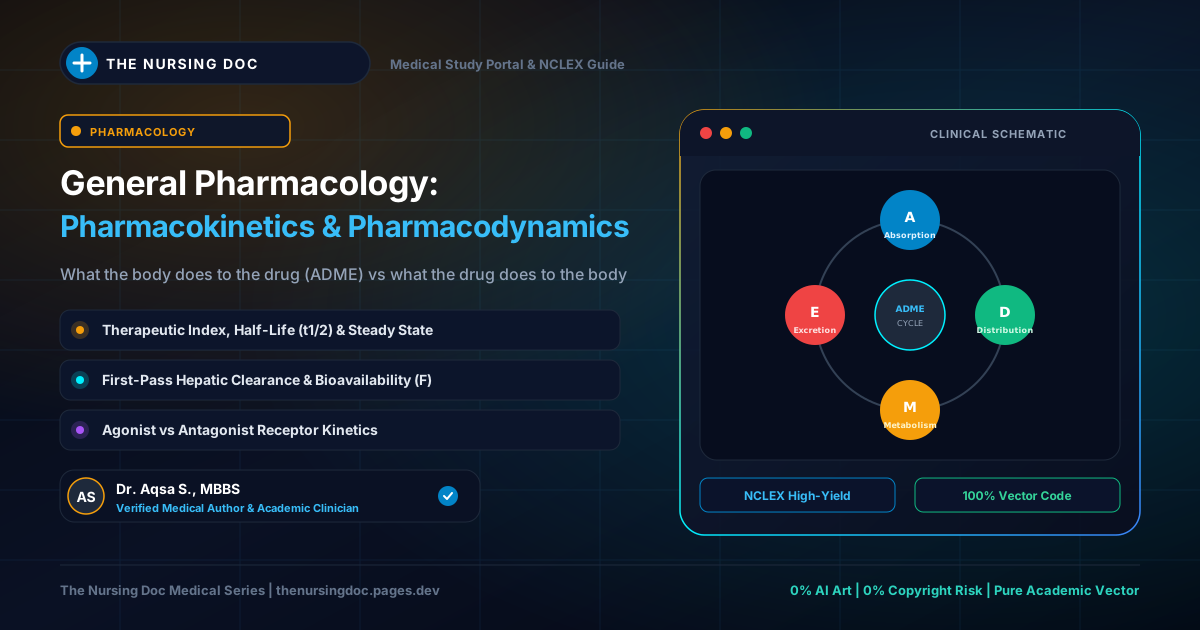
The Dual Pillars of Pharmacology: Pharmacokinetics vs. Pharmacodynamics
Topographical distinction between what the body does to the drug (ADME) and what the drug does to the body
1. Foundational Definitions in Pharmacology
Pharmacology represents the comprehensive body of biological and chemical knowledge concerned with the interactions between exogenous chemical substances (drugs) and living biological systems.
Pharmacodynamics: What the drug does to the body (mechanism, effect).
The Nature of Drugs: Chemical Size & Selectivity Thresholds
Therapeutic drugs encompass an enormous spectrum of chemical structures: simple inorganic ions (Lithium, MW 7), nonpeptide organic compounds, small peptides, massive proteins, nucleic acids, lipids, and carbohydrates. In nature, many drugs exist as alkaloids (plant-derived organic molecules containing a basic/alkaline nitrogen atom).
The Molecular Weight (MW) Selectivity Window (100 to 1,000 MW):
Most orally active medications fall within a precise molecular weight window between 100 and 1,000 daltons:
- Molecules Smaller than MW 100: Rarely possess enough unique structural topography to bind selectively to a single receptor subtype (e.g., Lithium is notoriously non-selective and has a narrow therapeutic window).
- Molecules Larger than MW 1,000: Do not diffuse readily through biological lipid membranes or endothelial junctions between body compartments.
- Biological Macromolecules (MW > 50,000): Therapeutic antibodies (monoclonal antibodies), thrombolytic enzymes (Alteplase), and peptide hormones (Insulin) must be delivered parenterally (IV, subcutaneous) and are manufactured commercially using recombinant DNA biotechnology.
Chemical Drug-Receptor Bonds
The stability and duration of a drug's action are determined by the nature of the chemical bonds anchoring it to its receptor pocket:
Pharmacodynamic Principles: Receptors & Efficacy
A drug receptor is a specialized regulatory macromolecule (enzyme, ion channel, transmembrane G-protein coupled receptor, or nuclear transcription factor) that mediates physiological signals. Receptors contain specific steric recognition pockets termed receptor sites that interact directly with the small drug ligand.
Agonists vs. Antagonists:
- Agonist: A drug that binds to a receptor and induces an active conformational change, triggering a biological intracellular response (e.g., Albuterol stimulating beta-2 adrenergic receptors to dilate bronchi).
- Antagonist: A drug that binds to a receptor with high affinity but produces zero intrinsic activation, physically competing with and blocking endogenous ligands (e.g., Propranolol blocking beta receptors).
- Enzyme Inhibitors: Some drugs mimic agonists by inhibiting metabolic degradation enzymes (e.g., Neostigmine inhibiting acetylcholinesterase, prolonging acetylcholine action).
Receptor Sites vs. Inert Binding Sites:
In addition to regulatory receptors, drugs bind to endogenous non-regulatory proteins in the body without producing a measurable biological effect. These are termed inert binding sites.
Primary Example: Plasma Albumin. Albumin binds acidic drugs (e.g., Warfarin). Drug bound to albumin is biologically inactive and cannot leave the vascular space, serving as a circulating reservoir. Only the "free" unbound drug can cross membranes, bind receptors, and exert pharmacodynamic action.
Drug Permeation: The 4 Pathways Across Biological Barriers
To achieve a therapeutic effect, a drug must move from its site of administration (gut, muscle, skin) into the systemic circulation and traverse endothelial and cellular membranes into target tissues. This movement occurs via four primary permeation pathways:
Figure 1: Cellular Pathways of Drug Permeation
Aqueous pores, transcellular lipid diffusion, carrier-mediated transport, and vesicular endocytosis
Fick's Law of Diffusion & Henderson-Hasselbalch Ionization
Fick's Law of Diffusion Explained:
Fick’s mathematical law dictates the rate of passive flux ($J$) of drug molecules across any biological membrane barrier:
- Concentration Gradient ($C_1 - C_2$): The greater the concentration difference between the donor side ($C_1$) and receiver side ($C_2$), the faster the absorption.
- Surface Area: Absorption is enormously accelerated in organs with massive absorptive surface areas (the small intestine with its villi and microvilli, or the alveolar beds of the lungs) compared to organs with small surface areas (the stomach).
- Membrane Thickness: Thin membranes (pulmonary alveolar-capillary barrier ~0.5 µm) absorb drugs almost instantaneously, whereas thick barriers (intact stratified squamous epidermis of skin) absorb drugs very slowly.
Water vs. Lipid Solubility & The Henderson-Hasselbalch Equation:
The vast majority of therapeutic drugs are weak acids or weak bases. Their ability to permeate lipid cell membranes is strictly dictated by whether they exist in an ionized (charged) or non-ionized (uncharged) state:
The ratio of ionized to non-ionized drug is determined by the environmental pH and the drug's acid dissociation constant ($pK_a$), described by the Henderson-Hasselbalch Equation. When a weak acid (e.g., Aspirin, $pK_a \approx 3.5$) is in an acidic stomach ($pH \approx 1.5$), it remains largely non-ionized and is readily absorbed through the gastric mucosa!
Bedside Nursing Application & Pharmacology Safety Pearls
Fundamental principles of PK and PD dictate bedside medication administration, overdose interventions, and toxicity avoidance:
In severe aspirin toxicity, nurses administer IV Sodium Bicarbonate to alkalinize the urine ($pH > 7.5$). In an alkaline urine, the weak acid aspirin converts entirely into its ionized charged form, trapping it in renal tubules and accelerating urinary excretion!
Warfarin is 99% bound to inert albumin. If a patient takes high-dose Aspirin or Ibuprofen, the NSAID displaces Warfarin from albumin sites. The sudden surge in "free" active Warfarin causes catastrophic hemorrhage.
Drugs with low molecular weights or poor selectivity (like Lithium, MW 7, therapeutic level 0.6–1.2 mEq/L) have dangerous toxic thresholds. Nurses must religiously draw trough levels and monitor for signs of toxicity (tremors, ataxia, arrhythmias).
Quick-Review Summary: Core Pharmacology Concepts
| Parameter | Primary Category | Mechanistic Definition | High-Yield Clinical Example |
|---|---|---|---|
| Pharmacokinetics | Body on Drug | Absorption, Distribution, Metabolism, Excretion (ADME) | Hepatic first-pass effect & renal clearance |
| Pharmacodynamics | Drug on Body | Receptor binding, dose-response, biochemical action | Beta-blocker reducing heart rate via SA node |
| Agonist | Receptor | Binds receptor and elicits active biological response | Albuterol (Beta-2 bronchodilation) |
| Antagonist | Receptor | Binds receptor without activation; blocks agonists | Naloxone (blocks Opioid receptors in overdose) |
| Lipid Diffusion | Permeation | Passive passage of non-ionized drug through bilayer | Anesthetics crossing Blood-Brain Barrier |
| Ion Trapping | Permeation | Ionization shift in pH compartments preventing reabsorption | Sodium Bicarb for Aspirin intoxication |
Curated and medically verified by Dr. Aqsa S. for nursing students.
← Back to All Study Notes