Dosage Form Science & Pharmaceutics: Drug Delivery Systems, Excipient Dynamics, & Clinical Classifications
Discover the foundational science of dosage form design. Learn how pharmaceutics transforms raw chemical entities into safe, palatable medicines through functional excipients—including vehicles, binders, disintegrants, surfactants, and hydrocolloids.
Curator & Medical Director, The Nursing Doc • Peer Reviewed Clinical Notes
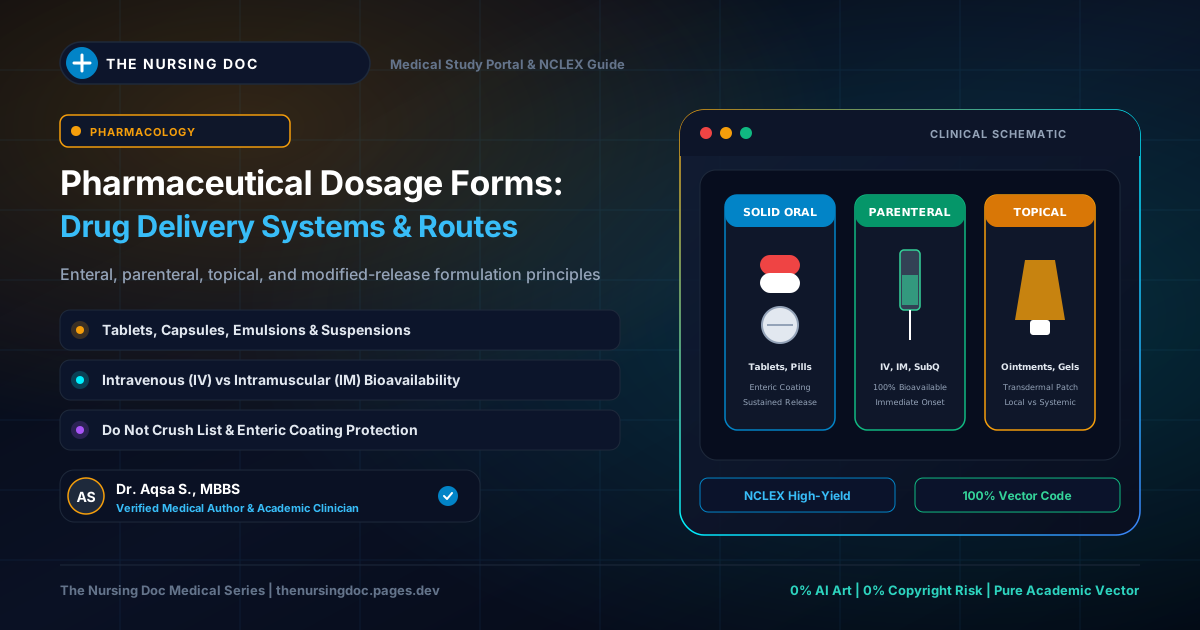
⚡ Quick Clinical Snapshot: The Anatomy of a Medicine
- Drug vs. Medicine: A drug (Active Pharmaceutical Ingredient / API) has pure biological action but cannot be administered raw; pharmaceutics adds non-drug additives (excipients) to convert the API into a safe, bioavailable medicine.
- The Excipient Arsenal: Diluents provide bulk; binders glue powders into granules; disintegrants swell upon contact with gastric fluids to burst tablets apart; lubricants prevent machinery friction; glidants optimize powder flow.
- Surfactants & Emulsions: Amphiphilic molecules with polar heads and non-polar tails lower interfacial tension, allowing water and oil to mix into stable emulsions.
- Hydrocolloids (Suspending Agents): High-molecular-weight polymers (e.g., Acacia, Methylcellulose) increase vehicle viscosity, dramatically slowing particulate sedimentation in oral suspensions.
- Preservative Obligation: Multi-dose liquid and parenteral preparations require antimicrobial preservatives (e.g., Benzalkonium chloride) because aqueous sugar media foster rapid microbial growth.
From New Chemical Entity (NCE) to Clinical Drug Delivery Systems
1. Foundational Concepts: Pharmaceutics vs. Drug Delivery Systems
In modern healthcare, a raw chemical molecule discovered in a research laboratory cannot simply be administered directly to a patient. The science that bridges pure medicinal chemistry with clinical bedside administration is Pharmaceutics.
Pharmaceutics
The specialized branch of pharmacy that deals with the conversion of a New Chemical Entity (NCE) into a proper, clinically viable dosage form. Often defined as "the science of dosage form design." Put simply: Pharmaceutics converts a drug into a medicine.
Drug Delivery System
The engineered technology and formulation used to administer a drug or medicine to a living biological system to elicit its desired therapeutic action (cure, disease management, or prophylaxis). Medicines serve as delivery systems designed to administer drugs safely, efficiently, and conveniently.
Dosage Form
The physical form of a dose of a drug (e.g., tablet, capsule, injection, ointment). Dosage forms are finished pharmaceutical products involving a precise blend of active drug components and non-drug excipients.
2. The Active Medicament vs. Pharmaceutical Excipients
Every manufactured medicine consists of two distinct chemical components:
💉 Active Pharmaceutical Ingredient (API / Medicament / Medicinal Agent)
The chemical substance in a medicine that exerts the actual pharmacological action on physiological tissues (e.g., Aspirin for anti-inflammatory cyclooxygenase inhibition, Insulin for cellular glucose uptake, Digoxin for cardiac inotropic support).
🧪 Additives & Excipients (The Inactive Matrix)
Substances other than the active medicament in the formulation that do not possess any intrinsic pharmacological action. Excipients are deliberately incorporated for three critical pharmaceutical purposes:
- Geometric & Physical Integrity: To give a particular shape, structure, and volume to the formulation.
- Physicochemical & Microbiological Stability: To preserve the drug against oxidation, hydrolysis, and bacterial colonization.
- Palatability & Elegance: To mask offensive tastes, provide appealing colors, and optimize patient adherence.
3. Functional Excipient Encyclopedia: Roles, Mechanisms, & Examples
Formulation scientists select excipients based on chemical compatibility and therapeutic objectives:
A. Vehicles & Semisolid Bases
A vehicle is the liquid, semisolid, or solid medium in which active ingredients are dissolved, suspended, or dispersed:
- Ointment Bases: Soft paraffin, Liquid paraffin, Wool fat (lanolin), Wool alcohol, Beeswax.
- Suppository Bases: Theobroma oil (cocoa butter - melts at body temp 37°C), Glycerogelatin, Polyethylene glycols (PEG).
B. Solid Dosage Form Excipient Matrix (Tablets & Capsules)
Examples: Lactose, Microcrystalline cellulose, Starch, Sorbitol, Kaolin.
Examples: Acacia, Sodium CMC, Gelatin, Liquid glucose, Povidone (PVP).
Examples: Starch, Croscarmellose, Sodium alginate, Alginic acid.
Examples: Magnesium stearate, Talc, Stearic acid.
Examples: Colloidal silicon dioxide (Aerosil), Corn starch, Talc.
Sweeteners: Sucrose, Mannitol, Aspartame. Flavors: Peppermint, Cherry, Menthol.
C. Surfactants & Hydrocolloid Suspending Agents
🫧 Surfactants (Surface Active Agents)
Substances that dramatically lower the interfacial tension between two immiscible phases (e.g., oil and water), rendering them miscible and enabling drug dissolution.
Amphiphilic Molecular Structure: Surfactant molecules contain a polar (hydrophilic) head and a non-polar (lipophilic) tail. At interfaces, the polar head orients toward the aqueous phase while the lipophilic tail embeds into the oil phase.
- Anionic: Sodium lauryl sulphate (SLS), Dioctyl sodium sulfosuccinate.
- Cationic: Benzalkonium chloride (also acts as potent antimicrobial).
- Non-ionic: Glyceryl monostearate, Spans (sorbitan esters), Tweens (polysorbates).
🍯 Hydrocolloids (Suspending & Viscosity Agents)
High-molecular-weight hydrophilic polymers that swell in water to form viscous colloidal dispersions, suspensions, or gels. In suspensions, they increase vehicle viscosity, thereby slowing the sedimentation rate of insoluble drug particles (governed by Stokes’ Law).
• Natural Gums: Acacia, Tragacanth, Agar (plant); Gelatin (animal); Bentonite, Veegum (mineral clay).
• Semi-Synthetic Cellulose: Methylcellulose, Sodium CMC, Hydroxypropyl methylcellulose (HPMC).
• Synthetic Polymers: Carbomers (Carbopol) and Polyox resins.
D. Stabilizers: Preserving Potency & Sterility
Pharmaceutical Stability denotes the capacity of a formulation in a specific container to remain within physical, chemical, microbiological, therapeutic, and toxicological specifications over its shelf life.
4. Comprehensive Classification of Dosage Forms
Dosage forms are classically categorized across two primary axes: by Physical Form and by Route of Administration:
| Physical State | Dosage Form Types | Defining Characteristics | Clinical Route & Examples |
|---|---|---|---|
| Liquid |
• Solutions • Syrups (high sugar concentration) • Elixirs (hydroalcoholic clear liquid) • Suspensions (insoluble solid in liquid) • Emulsions (oil-in-water or water-in-oil) • Magmas & Milks |
Homogeneous molecular dispersions (solutions) or coarse biphasic dispersions (suspensions/emulsions). High bioavailability; fast absorption. | Oral, Parenteral, Ophthalmic, Otic e.g., Amoxicillin oral suspension, Digoxin elixir, Propofol emulsion (IV). |
| Solid |
• Tablets (compressed, chewable, enteric) • Capsules (hard & soft gelatin) • Powders & Granules • Lozenges / Troches |
Highest chemical stability, exact unit dosing, easy transport, and taste masking. Undergoes dissolution in vivo. | Oral, Sublingual, Buccal e.g., Nitroglycerin SL tablet, Enteric-coated Aspirin, Omeprazole capsule. |
| Semisolid |
• Ointments (greasy hydrocarbon base) • Creams (emulsion base, less greasy) • Pastes (high solid content > 20-50%) • Gels (aqueous colloidal cross-linked) |
Formulated for localized dermal adhesion or percutaneous systemic absorption; soothing and protective barriers. | Topical / Transdermal e.g., Hydrocortisone cream, Zinc oxide paste, Diclofenac gel. |
| Specialized |
• Suppositories (rectal / vaginal) • Inhalers & Nebulizers • Transdermal Patches |
Engineered for localized mucosal action or systemic delivery bypassing first-pass hepatic metabolism. | Rectal, Vaginal, Pulmonary e.g., Acetaminophen suppository, Albuterol MDI, Fentanyl patch. |
NCLEX & Bedside Nursing Alerts
Crucial administration rules governing dosage forms and excipient safety
📝 NCLEX-RN Practice Check: Pharmaceutics & Dosage Forms
Question 1: Which pharmaceutical excipient is specifically incorporated into compressed tablet formulations to cause the tablet to swell and break apart into smaller particles upon contact with gastric fluid?
A) Diluent (e.g., Kaolin)
B) Glidant (e.g., Colloidal silica)
✓ C) Disintegrant (e.g., Sodium starch glycolate, microcrystalline cellulose)
D) Anti-adherent (e.g., Talc)
Question 2: A nurse is caring for an 8-month-old infant receiving amoxicillin oral suspension at home. What is the most critical instruction the nurse must provide to the parents regarding drug preparation?
A) Mix the dose with hot formula milk to enhance dissolution.
✓ B) Shake the suspension thoroughly before measuring each dose to ensure uniform drug distribution.
C) Dilute the suspension with mineral oil to avoid gastrointestinal upset.
D) Freeze the remaining liquid between doses to preserve stability.